
TMJ and Headaches
TMJ (Jaw Problems & Headaches) - T-Scan technology
We are one of the few dental practices in the UK to use the exciting new Tecscan technology which can be used to precisely analyse your bite and help treat the following-conditions:
- Headaches
- Jaw pain
- Teeth grinding
- neck and shoulder pain
- sinus problems
Get in touch today!
Frequently Asked Questions
Why is it important to measure the force of a bite?
It is often the case that these problems arise from what is called the ‘maloccusion’ of your bite. This means your bite is unbalanced and extra stress is put on the surrounding muscles of your mouth.
How does T-Scan work?
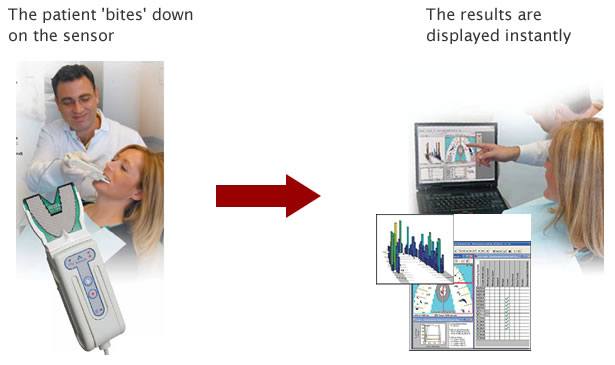
It is really simple – all the patient has to do is bite down on an ultra-thin sensor. The software renders a dynamic analysis of your bite on the computer which enables us to identify contact points on individual teeth and the relationship to all other tooth contacts. A balance indicator guides adjustments using simple, understandable graphic displays.
The results can be combined with periodontal charting, X-ray and tissue exam data to provide a complete assessment of your oral health.
Treatment
Using the T-scan technology, we are able to instantly assess the orgin of the headaches or pain and then recommend a course of treatment for you.
Treatments may include an NTI appliance or a night time acrylic splint. You may also require other dental work in order to re-establish your bite.
Arrange a Consultation
Speak to us about treating your headaches today.
Call 01793 521646
Information about headaches
What is dental occlusion?
Dental occlusion is another name for the way your teeth meet when your jaws bite together.
What is TMJ?
The letters TMJ are short for of ‘temporo-mandibular joint’, which is the joint connecting your lower jaw and your skull. The movement in this joint lets you open and close your mouth and chew from side to side.
What kind of problems might I have?
If your teeth don’t fit together properly, you can have problems not only in your teeth themselves, but also the gums, the temporo-mandibular joint or the muscles that move your jaw. These problems are called ‘occlusal’ problems.
- Teeth
Teeth that are out of line, heavily worn or constantly breaking, fillings that fracture or crowns that work loose may all be signs of occlusal problems. Your teeth may also be tender to bite on or may ache constantly. - Gums
Loose teeth or receding gums can be made worse by a faulty bite. - TMJ
Clicking, grinding or pain in your jaw joints, ringing or buzzing in your ears and difficulty in opening or closing your mouth could all be due to your teeth not meeting each other properly. - Muscles
If your jaw is in the wrong position, the muscles that move the jaw have to work a lot harder and can get tired. This leads to muscle spasm. The main symptoms are continual headaches or migraine, especially first thing in the morning; pain behind your eyes; sinus pain and pains in your neck and shoulders. Sometimes even back muscles are involved.
How can I tell if I have a problem?
You may find that you clench or grind your teeth, although most people who do aren’t aware of it. Sometimes can be caused by anxiety, but generally most people clench their teeth when they are concentrating on a task – housework, gardening, car mechanics, typing and so on.
You may wake up in the morning with a stiff jaw or tenderness when you bite together. This could be due to clenching or grinding your teeth in your sleep. Most people who grind their teeth do it while they are asleep and may not know they are doing it.
If you suffer from severe headaches, or neck and shoulder pain, you may not have linked this with possible jaw problems. Or you may keep having pain or discomfort on the side of your face around your ears or jaw joints or difficulty in moving your jaw. These are all symptoms of TMJ problems.
If you are missing some teeth at the back of your mouth, this may lead to an unbalanced bite, which can cause uneven pressure on your teeth.
Together, all these symptoms are called ‘TMJ syndrome’.
How are occlusal problems treated?
Depending on the problems you are having, it can be possible to spot the signs of an occlusal problem. Various muscles may be sore when tested, or the broken and worn areas of your teeth will show you are grinding your teeth – a common sign of an incorrect bite.
If your dentist suspects that your problems are due to an incorrect bite, he or she may help to diagnose the problem by supplying a temporary soft nightguard or hard plastic appliance that fits over your upper or lower teeth. This appliance needs to be measured and fitted very accurately so that when you bite on it, all your teeth meet at exactly the same time in a position where your muscles are relaxed. You may have to wear this all the time or, just at night. If the appliance relieves your symptoms then your bite may need to be corrected permanently.
- Tooth Adjustment (equilibration)
Your teeth may need to be carefully adjusted to meet evenly. Changing the direction and position of the slopes that guide your teeth together can often help to reposition the jaw. - Replacement of teeth
The temporo-mandibular joint needs equal support from both sides of both jaws. The chewing action is designed to work properly only when all your teeth are present and in the correct position. Missing teeth may need to be replaced either with a partial denture or bridgework.Replacement is not usually done until a diagnosis has been confirmed by using an appliance and this has fully relieved the symptoms. Relief in some patients is instant: in others it can take a long time.
- Medication
Some drugs can help in certain cases, but this is usually only temporary. Hormone replacement therapy may also help some women.
Diet and Exercise
As with any joint pain, it can help to put less stress on the joint. So a soft diet can be helpful, as can Corrective exercises and external heat. Physiotherapy exercises can often help, and your dentist may be able to show some of these to you. - Relaxation
Counselling and relaxation therapy may help in some cases. These techniques help the patient to become more aware of stressful situations and to control tension.
Will straightening my teeth help?
If your teeth are too far out of line or in a totally incorrect bite position, it may be necessary to fit an orthodontic appliance to move them into a better position.
How many people suffer from these problems?
Up to 1 in 4 people may have some symptoms. Both men and women are affected equally, although women tend to seek treatment more often than men. The symptoms can often start with the menopause or other hormonal changes.
Many people have imperfect occlusion and missing teeth, yet never have symptoms because they adjust to their problems. Occasionally, in times of increased stress and tension, the symptoms may appear and then go away immediately. Or, your teeth and gums may be affected straight away and instead of headaches, you may suffer:
- flattened, worn teeth
- broken teeth, fillings and crowns
- loose teeth
- continual sensitivity of your teeth to temperature change
- toothache with no apparent cause.
“All the staff there are extremely friendly and helpful … the environment is extremely pleasant – most of my friends have changed over to the Brunel surgery and they are as happy as I am! Going to the dentist is now no longer something to fear!”
Mrs T, Swindon